
What we do
We provide sustained, relational support to families through schools, grounded in our values of nurture, social justice and shared authority.
We do this by building partnerships with schools and developing their existing members of staff into School-Based Pathfinder Workers. Reaching families through schools make sense because for some, school is one of the few constants.
Our practice
Pathfinder support is completely optional for families, but once they sign up, this support is available to them for as long as they need or want it. We describe it as support ‘on tap’.
Each family’s School-Based Worker is themselves mentored, supervised and linked into our wider ecosystem of services and helping agencies by our Core Team of expert Coordinators and Practice Supervisors. This equips them to act as a trusted conduit for families to get access to exactly the help they need, including advice from our in-house CAB service.
Our offer of open-ended support allows real trust to be built between workers and families, which is so essential to resolving issues that might otherwise escalate, particularly when people are facing multiple and complex adversities.
We use ‘Psychologically Informed Environments’ (PIE) as the foundation of our practice, meaning our work is trauma informed. We also offer PIE and NVR (Non-Violent Resistance) training to schools and families.
We have a family emergency fund and distribute donations from the West Midlands Multibank and The Hygiene Bank.
‘Shared Authority’
We go beyond providing support, and work to enable and empower families to take action in their own right. What this looks like varies, but some Pathfinder family groups have formed to provide support and nurture to each other; some are finding their voice to speak out about issues that concern them, or to tell organisations how to serve them better; some are taking action in their community. We know that with the right support and connections, the strength, creativity and resilience of families facing adversity can be incredible.
A networked approach
The Pathfinder is more of a network than an institution. We bring together people from across primary, secondary and special schools, Children’s Social Care and the voluntary sector.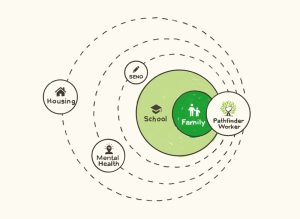
We aim to ‘infuse’ the institutions of our community with our values, principles, and approach.
Working with schools in particular to repurpose and develop their existing members of staff means we reconfigure existing capacity in the system around shared values and intentions – making the most of what already exists.
Our ambitions
Our work in south Birmingham to create and continually develop and grow the local Pathfinder ecosystem is a demonstration that it is possible to reconfigure local systems and services to provide what children and families say they want and need. We share our experience of doing this and advocate for change more widely.
We are deeply embedded in our place and there is always more for us to do to tend to our networks and develop offshoots and innovation from within them – our workers and families are full of creativity and new ideas.
 We also want to support others to grow their own Pathfinder approaches that are rooted in other local places. We are keen to make connections with other frontline workers, headteachers and/or system leaders (ideally all three in the same place!) who are also ambitious for change and are interested in working with us.


Pathfinder Approach
Schools are supported to develop their confidence and expertise in early help and family support.
We partner with schools to identify staff to become designated schools-based Pathfinder workers.
We then collaborate with schools to identify families who need support and the school-based Pathfinder staff become trusted key workers for these families.
The Pathfinder multi-disciplinary core team provide the school-based workers with support, supervision, mentoring (co-working cases) and warm supported introductions to specialist services (substance misuse, benefits advice, housing, domestic abuse etc).
Our practice is grounded in PIE (Psychologically Informed Environments) and is trauma-informed.
Families experience sustained, flexible, relational support
The Pathfinder provides a simple interface (through schools) for families to access support.
We work with families who are contending with complex interconnected issues including trauma, mental ill health, domestic abuse, misunderstood/undiagnosed SEND, criminal exploitation, poverty, inadequate housing, physical health problems and violence outside the home.
The Pathfinder’s flexible and relational way of working unlocks a fuller picture of what each family is facing and it makes progress possible.
Pathfinder workers encourage, mentor, suggest new ideas, advise, monitor progress, challenge, advocate and make supported introductions to those who can help. They provide a consistent presence through transitions (including between educational institutions) and crises.
Positive relationships with other agencies are supported
Where Pathfinder families are or have become involved with statutory children’s services, the Pathfinder worker is able to support families and social workers so that the process can be as positive and constructive as possible.
Families develop their own networks for peer support and to make change for themselves
The Pathfinder supports families to organise their own groups to support each other. Increasingly these groups are interested in using their experiences of social problems and system failures to advocate for change.
The Pathfinder’s keystone values are absolutely integral to the work.
They are:
- Shared authority: We are moving away from the traditional client-agency imbalance of power, and instead recognise the value of co-production; the expertise of lived experience; the value of peer support; and the importance of a non-judgmental approach. Shared authority is built upon a relational model of working where we encourage parents and young people to create formal structures that can shape practices and policies.
- Nurture: We work with compassion, empathy and positive regard.
- Commitment to social justice: We elegantly challenge systems that disadvantage families.
The values are a critical element of the Pathfinder model, we reflect on them daily, and they act as a compass in everything we do.
We offer Psychologically Informed Environments (PIE) and Non-Violent Resistance (NVR) training for the school-based Pathfinder workers we support and the wider school community, including parents.
PIE training supports schools (and families, and the Pathfinder team!) to become Psychologically Informed Environments which take into account previous trauma and the psychological needs of everyone involved, including workers.
NVR trains parents and caregivers in how to respond effectively to challenging behaviour in children, adolescents and young adults.
Often it is the experience of building trust and connection through training together that leads to families setting up their own shared authority (peer support and action) groups.
This training is provided through our long-standing collaborative relationship with St. Basil’s, the youth homelessness charity.
Our Testimonials
Kind words families and other stakeholders have said about us:
“Attendance has improved and his condition is improving and we can see [he] feels more part of his class and is making social connections.” – School
“Pathfinder has the understanding that it wasn’t quite as simple as ‘just doing it’.” – Mum
“[It was] more empowering. At the end of the day, if I don’t make the changes and do it for myself then nothing is going to change.” – Mum